Sunday, April 19, 2015

I see the parrot sound

This is how one of the student in the Sapience Montessori spoke in his early attempt of conversing in English at the end of first year. In India, a child normally speaks in his mother tongue which is different than English. His English conversation therefore starts in a set up of Montessori, either at the end of the first year, or at the start of second year.


How can a child, whose mother tongue is not English, converse in foreign tongue of English in one year. Montessori makes this possible by using three tools:

1. Adults converse with children in English from Day 1: At the age of 3, the child is absorbing language. This is how he learns his mother tongue from his parents. The same method is used with English. For instance, all instructions like 'please tie apron' or 'please pick the pounding material', 'please take the chair for eating' and so on are spoken in English. However, as the child does not understand English at all, after every English instruction, the instruction is converted into his/her mother tongue so that the child can understand. With every passing day, the child is more and more comfortable in English.

2. Increase his English Vocabulary by 100 words a month: As the child is getting comfortable with English, he is introduced to English words for all the normal objects he sees in the house. For instance he is introduced to objects in the kitchen, bathroom, living room. He is introduced to names of games, cars, trucks and other water vehicles, musical instruments. Animals, vegetables, fruits are other normal categories introduced to the child. With his vocabulary of English increasing every day, the child is ready to speak in English

3. Mistake-tolerance created by Montessori environment: When the child is going to speak English, he is going to make mistakes, infact lot of them.It is therefore important for the child to not feel embarrassed with his mistakes and continue to try to 'speak' even if it is wrong. Mistakes, instead of creating guilt, should be the source of finding one errors quickly and then correcting it.

Whatever mistakes are known to the child are due to the self-corrective nature of most of the material. Child knows her mistake through control of errors like that are designed in many activities such as when the pounding spills on the oil cloth, or water spilling. And when a mistake is committed by the child, the adult is not supposed to 'tell' this to the child. Montessori creates this environment where mistakes are not even 'commented', leave alone 'punished'. Mistake tolerance is Montessori's unique contribution to the development of the child which allows the child to take on challenges without the fear of losing their self-respect.

Summary

By the end of first year, the child has the confidence to 'speak' in English and knows 'sounds' of many objects. In the second year, the child learns to 'construct' words from the sounds of object. This word creation and construction of simple sentences - Noun and verb - enables him to 'write' English.

In the third year, the child is introduced to Grammar ( Noun, Verb, Article, Adjective, Adverb) so that he can decipher 'long' sentences'. By the end of third year therefore, a child in Montessori can 'read' English and understand it. It is called 'Total reading" in contrast to 'Mechanical reading'. Mechanical reading is 'reading' each word without understanding the sentence.

And this starts the 'next' virtuous cycle of the child. Because the child can 'read' books, she enjoys reading. That in turn increases her vocabulary. Which in turn makes it easy for the child to 'speak' and converse. This in turn increases her 'subject knowledge'. And on and on.

Putting in your child in the virtuous spiral of  language is the best way to ensure that the child becomes 'smart'. I do not know of any method of education, apart from Montessori method, which teaches language like English as beautifully. But if you can initiate this spiral with  your mother tongue - Hindi, Marathi, or Kannada - this also helps the child equally well. The child should however be introduced to the literature of mother tongue fairly early.

In short, learning language for the child is not just about communicating. But it is about opening up his windows and doors for more and more learning which can be 'powered' by the child himself. 

Photo credits: YIM-Hafiz / Flickr

Monday, March 30, 2015

Slow is Fast in Montessori preschool

Piyush, a parent of 3 year old child, called me up as he had gone to a Montessori pre school for getting admission for his child in Montessori (M1 to M3) preschool. After hearing what a child learns in the first year of Montessori - M1 - Piyush said that he was disappointed. According to him, while in a normal pre-school, the child learns to write alphabets A to Z, count numbers 1 to 100, learns to sing rhymes, a child in Montessori M1 does not learn any of this. So Piyush asked me if this is because Montessori offers too much of freedom to the child? Is the progress of child in Montessori too slow?


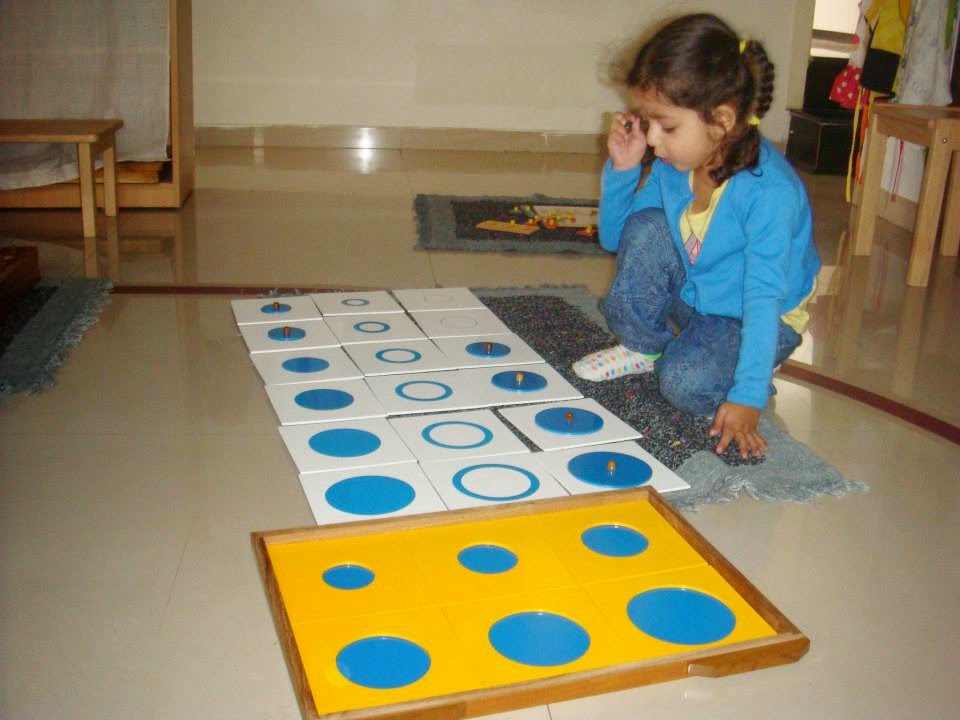
A girl doing Geometrical cabinet by the end of first year in M1 which requires 35-40 minutes of focused attention 

If you compare M1 (equivalent to Nursery) to Nursery year of a normal pre-school, the above statement may seem to be true. So why is the first year slow in Montessori?

Because in the first year, the foundation is being led. The initial period is spent on helping the child sit on the mat without getting distracted. This is done through EPL activities like pounding, cutting cucumbers and self management activities like buttoning shirt and washing hands. In the first year, sensorial activities utilise the 'senses' of the child which help him activate his 'senses' and develop patience. A large set of practices are adopted in Montessori to ensure that the child sees 'mistakes' as a source of learning, instead of being embarrassed or punished by them. As a foundation for teaching English, the child is introduced to at least 100 new words in English per month in the first year through cards and object boxes. Morever, the Montessori adult always speaks with the child in English. Combination of these -  EPL, Sensorial and language - enable the child to work patiently for a longer time without fear of 'mistakes'. 

By the end of first year, with the attention span increased to more than 30 minutes, with no fear of mistakes, the child is willing to learn new things at a faster rate, be it in language, mathematics or Geography. More importantly, his learning is fast because he chooses his activities himself without being forced. He learns it individually at his own pace, not in the group.

So what does this foundation of one year help the child learn in the second and three year of pre-school? By the third year, a Montessori child learns to count add, subtract, multiply and divide 4-digit numbers. Some children even learn fractions. All children learn to count 4-digit number, some even count 6-digit numbers. ( Typically this is learnt in second/third class in normal schools!) In English language, the Montessori child not only speaks, writes English in his own words, but can also read English story books ( which is called comprehensive reading as compared to Mechanical reading). As though this is not enough, a Montessori child is introduced to Geography, Zoology and Botany ( with botanical names for leaves) in the third year, besides being introduced to second language, which could be either Hindi or Marathi in Maharashtra, or Kannada in Karnataka.

At the end of three years, a Montessori child is far ahead of a child in Normal pre-school, both in terms of learning ( be it maths, language or geography) as well as in terms of development ( be it patience, concentration and ability to make his own choices). Piyush understood the benefits of laying doing sound foundation of a child.

As Piyush said it succinctly, Slow is fast in Montessori. It takes time to lay down the foundation in the first year, but once it is laid, then it can achieve huge results in the next two years. 

Saturday, January 24, 2015

Montessori is not activity based learning

Because of the numerous activities used in Montessori method, Montessori is often confused with Activity based learning. However, Montessori method instead strives to re-configure the balance between EAN ( Execution Attention Network) and DMN ( Domain mode Network). EAN is used when the child does activities, while DMN is used with the child is doing internal focused tasks like, daydreaming, reflecting, and changing the perspective. When a child uses activity alone, it is considered to be autistic because he is using too much of EAN, and when a child uses DMN, we consider it to be schizophrenic. The key is balancing EAN and DMN.


Here is how Montessori method balances the EAN and DMN in a pre-school: 

1. Utilising Sense of order

Montessori method uses the time before and after an activity. That is why it stresses on the importance of taking the kit from the shelf as well as keeping it back on the shelf. It also uses the child's sense of keeping things in order such as when the child keeps the boots on the rack, hanging the bag on a specific place and so on. These 'non-activities' use the DMN network of a child.

2. Doing an activity end to end

In Montessori method, EPL activities for instance, have several steps before the activity and after the activity. For instance , pounding activity has several steps before the activity (taking the apron, using oil cloth, taking the nuts in a vessel, putting it in the pastle) of pounding. Similarly, there are activities after pounding. Infact one of the central activity is sharing the pounded nuts with other children. This series of activities enable the child to look at the 'purpose' of an activity and not just the key activity. Shifting the attention to the purpose of activity enables the child to balance between DMN and EAN networks.

3. Creating child-centric method


Unlike any ABL method, the child can 'chose' his own set of activity and perform it as many time as he wishes. As long as the child sits on the working mat, child has freedom of not doing anything in Montessori method. In Montessori, child's voluntary efforts to do any activity are considered to be important if his learning has to happen. Montessori method is student-driven method while ABL is teacher-driven method.

4. Focus on behavioural pattern of child to imbibe the learning habits 

In Montessori, there are EPL, Sensorial, Language and Mathematical activities arranged according to the age of child. These activities, although predetermined, are offered to the child according to his age and the challenge it offers to the child. The focus is not on teaching a 'concept' to a child like in ABL. The focus is on developing three 'behavioural habits/patterns' of a child that aid the child in deepen his learning such as choice, mistake-fearlessness, and patience. Montessori method is development centric method, while ABL is learning-centric method.

Summary

In short, Activity based learning is learning-centric teacher-driven methodology while Montessori method is development-centric student driven methodology.

On the surface, Montessori method looks like an activity based method. But if you scratch the surface and delve deeper, you will realise that activity is used as a 'tool' to serve a different 'end'. In Montessori, Activities are used to help the child to develop the foundation of the personality of a child while in Activity based method, activities are used to help the child learn something better and faster.

Tuesday, December 2, 2014

To alter child's behaviour, it is important to follow the child

If you have read the last month's blog on five levels of learning, you will understand that the school mainly helps the child in learning at a cognitive level ( Level 1 to 3). But some alternative schools, like Waldorf and Montessori, also help the child in developing the 'appropriate behaviours' by following the child.  Here is one example that happened in a Montessori.

In Montessori, adults ( or teachers) are taught to follow the child. This example of learning, described below, occurred at the dining table of a Montessori.


Two children, let us call them Neil and Saket, were eating their tiffin on the dining table. Neil had brought Sabudhana Khicdi , which Saket loves very much. Saket therefore asked for a tbsp of Khichdi to Neil. Neil refused. Saket asked the Montessori Adult to intervene. In such situations, Montessori adult takes a back seat and follows the child. So she asked Saket to directly request Neil. Saket again requested Neil for Khichdi. 

After sometime, Neil gave him a tbsp of khichdi. Saket ate it. But he asked for more. Saket was not eating his tiffin. He kept on looking at Neil's tiffin. He even tried once/twice to directly take the Khichdi from Neil's tiffin. Neil blocked Saket's hand. Saket continued to request, very emotionally. After sometime, Neil again gave him a tbsp of Khichdi. Saket ate it quickly and again asked for more. Then he waited for Neil to give him Khichdi. Neil again gave him a tbsp after some time. Again Saket ate and waited. This drama continued for 10-15 minutes. During this 10-15 minutes, Neil gave him 5-7 tbsp of Khichdi. Saket continued to ask for more but also waited. Neil, who normally does not finish his tiffin, ate his full tiffin that day. Saket waited until his Khichdi was over and then he opened his tiffin. 

What did Saket learn? First, he learnt to request for something which he wanted. Generally children do not learn this. When they want something, they grab it, pull it or cry when they do not get it. Saket avoided these three actions and continued to request in a very right tone. Two, Saket learnt to wait patiently for Neil until he gave. This is perhaps the most difficult habit to learn. Patience. Saket learnt to practice 'patience'. More than anything this habit determines the extent to which the 'potential' of a child unfolds.

What did Neil learn? First, he learnt to 'share'. Neil is an independent child when it comes to eating. He neither asks for any 'food item' from others, nor does he 'give' it to others. For the first time in 4 months, time he 'gave', even though it was little. Surprisingly, 3 days after the event, he brought in Khichdi and gave it to Saket without being requested. No amount of 'cajoling' would have helped Neil's behaviour to change to 'sharing'. Second, he also learnt that 'requesting' for some food item is OK. Next day, Neil asked for a 'cheese dosa' from another girl student. Neil had changed his behaviour.

Many parents want their children to change their child's behaviour, for instance, the habit of sharing, waiting for someone, or requesting before shouting. But they resort to wrong methods - instructing, cajoling, black-mailing, or exhorting. Parents do not know that they cannot change their child's behaviour just by 'instructing' the child. Parents can only 'enable' the conditions and hope that the child learns from it.

Unfortunately, parents are too biased to notice learning situations.  For instance, when i told the above example later to parents, many fathers and mothers said that they would have asked their child 'not to ask for any food item' ( like Saket did). They think that it is akin to begging. Some parents also said that they would have asked their child to 'share'.

Some parents have intuitive sense of what should be done in a situation. But most parents do not know how to enable such 'dense situations' that are ripe for learning. Such dense situations - where emotions and real events happen - are required for learning. Once the situation has been 'enabled', it is important to step back and not interfere in the learning process by letting the 'biases' interfere. In the above example, Montessori adult ( or teacher) watched the proceedings without making any comment. She just followed the children. She was careful to see that Saket did not 'put' his hand in the tiffin of Neil, for instance. Neither did she ask Saket to eat his own tiffin and not 'ask' for anything.

This is a paradox. If you want to change the child's behaviour, it is important to 'follow the child', instead of leading the child. Many parents want to inculcate the right 'culture' ( or what they call 'Sanskar' in marathi or Hindi) in their children, but they do not know how.  Instead of following the child, they constantly try to lead the child.

Thursday, October 9, 2014

Learning is painful, individualistic and idiosyncratic

There is a huge difference between learning and teaching. To understand learning, one has to see it. But how can one see learning when learning happens in the head. So here is a chance to see learning 'happen'. See this video tape of live-learning of a young toddler, which will help us peep into the mind of a learner. 


After seeing this video ( of the child we shall call Adi), you will appreciate three characteristics of learning:

1. Learning is painful

We assume that learning is joy and fun. But contrary to this understanding, learning is painful. We watch this everyday in a Montessori. When a child is 'learning' something real, his face is taut and tense. When he cannot solve a problem, like Adi in the above video, the child is frustrated and often throws the 'items'. Sometimes the child yells and even beats someone closer to her.

Sometimes the pain of learning is seen differently. For instance, when the child works on something where he is learning, like Adi, the effort of learning is so high that he wants rest after doing the activity. Or if we praise 'right' outcome in activities, we have observed that the child avoids taking challenging activities later because he is more worried about performing poorly. 'Praising child for right performance' hampers the child learning. Carol Dweck has documented the effects of performance-anxiety and learning extensively.  Montessori therefore avoids praise.

As the child grows, he or she cannot show this pain easily to others. Instead of showing his frustration of learning, he shows it in more acceptable ways of defiance or disengagement. Without helping the child to assimilate the pain of learning, the child does not learn.

2. Learning is individualistic

Even if the classroom is full of students, every student learns at a different pace. If you see Adi's video above, one can imagine many different ways in which Adi could have been helped to finish the cylinder rods successfully and that too in lesser time. But would our help facilitate Adi's 'learning'? Help, at a wrong time in a wrong way, hampers learning.

In my working in a Montessori, I have realised that the 'right' timing of help is very very tricky. After many such attempts, I have discovered that Montessori's policy of 'not helping' is a better policy. As the child grows old, the policy of 'helping only when asked' is perhaps a better policy to facilitate learning. ( But that too requires planning by the teachers!) Helping a child definitely helps learning, but doing it without hurting the child's self-confidence is a bigger challenge. Help from other children is more effective than help from older adults for the child. And that is why, multi-age classrooms like that of Montessori are more helpful.

Homework system has got maligned in the education system. But due to homework, help from other sources is available to the child. In other words, if the parents can help the child do the homework with the right spirit, it actually helps the child get the right help before it is too late.

3. Learning is idiosyncratic

'Idiosyncrasy' means that learning can happen anytime anywhere. What is Adi learning while putting cylinders in the blocks? He is learning about the physical properties of length and diameters through his senses. He can learn the same 'properties' even when he is working with pink tower? Or trying to put screw in the right hole? Or when he is trying to put his legs in the right shoe? His learning of 'properties' can get 'completed' in any of this instances. Once the child 'sees' the problems, he uses other situations to connect with it. That is why even when the child fails in producing the right outcome, it does not matter.

In our normal coercive learning systems of schools, we always insist only on one 'right way' of learning. We do not help the child in connecting one 'learning problem' with other. When we are teaching latitude/longitude in Geography, for instance, we do not help him connect the same problem with 'Geometry'. Or we do not help him understand the concept of 'light' by showing how India has daylight when USA has night? When using arithmetic operations, you will observe some children struggling with subtraction and addition because of the difficulty in carrying forward 'the tens' in the decimal system. But the same child can easily calculate the amount of money he has to take from the vendor when he is buying toys. In short, Interconnections of concepts across subjects is a major source of learning that we miss in normal schools.

Here parents can immensely help their children. Life is interconnected; subjects in the schools are not. Parents can help their children learn if they can help the child interconnect the concepts in different subjects like geography to water management. Or demonstrate the relevance of concept in real life such as by showing how a bell works. Real-life demonstration like taking child to a real factory also helps.

Summary

Montessori method works because the environment is designed to be 'learning-friendly'. Right from the scientific kits to the method of teaching, everything is designed to help the child tackle the above learning difficulties. Every child is taught individually. That helps the child chose his own pace and convenience. When the child is stuck he learns from others while 'observing' others in the multi-age classroom, because the child can sit and 'do nothing' in Montessori . Because the child is not praised for right outcomes, the child is not afraid of poor performance.

And more importantly, the child is helped to connect his learning with day-to-day life in a continuous manner. For instance, the child connects 2D images of cards with 3D objects all the time. See this example of introducing vegetables with cards.

By laying proper foundation of learning-enabled child, child is helped for his life. It helps him use these practices of learning throughout his life even the external environment is less friendly.

Courtesy and copyright of video: Sapience Montessori House of Children 

Sunday, May 25, 2014

How Montessori method helps a child to increase his attention span

Every teacher of play school and parent assumes that a child will always be active, dancing and moving. Infact some parents also believe that more the child is noisy, more the intelligent she is. But every teacher knows that learning cannot happen until the child sits still and can focus on something for a reasonable period of time. Not just psychologists, every parent also knows this. So it is surprising that only Montessori method has definite methods to increase the attention span of a child.

Montessori does this impossible-looking feat through some innovative 4 design elements of kits, methodology, and use of child psychology. 

1. Montessori Kits are designed to fulfill the innate need of sensitive period. 

This helps the child to do what he most needs. Initially a child takes up EPL activities like pouring water, buttoning, and other activities that makes him independent. Later, the child takes up sensorial activities that uses his senses of sound, taste and touch. No activity is introduced to child until she is ready. For instance, child is introduced to writing only when his readiness is 'measured and identified' by drawing Geometrical insets. Therefore child loves to perform activities because it fulfills his innate need. 

2. In each kit, multiple activities are designed with increasing complexity to prevent onset of boredom . 

If the activities are not challenging, the child leaves the material immediately. That is why children rarely play with toys. In Montessori, multiple activities in  a single kit are designed with increasing challenge. For instance, in a cylinder block, almost 120+ activities can be performed which are increasingly difficult. Because the activities are challenging, the child does not feel bored and remains engaged with the same kit. A child is able to maintain his attention for a longer time. 

3. A child's internal drive is invoked by offering him the full freedom . 

A child has a freedom to perform anything in a Montessori. He can eat at any time, play if he is bored, or just still and do nothing. He also has a choice to repeat an activity n number of times. Her wishes are respected in the Montessori fully. This makes a child feel that he or she can do anything in the Montessori. Because the child realises that he/she need not 'manipulate' anyone to do anything, he is in command. This calms him from inside. This helps him perform the activities without any compulsion for a long time. He is driven by his internal force, rather than by any external pressure of approval from the teacher. 

 4. A child's motivation is kept intact by avoiding the pointing of mistakes as well as praise.

When a child's mistakes are pointed, even though with good intention, he/she is embarrassed and avoids situations and challenges that leads him to make mistakes. In a Montessori, the material kits are self corrective. This enables the child to correct his own errors himself. On the other hand teachers are also trained not to point mistakes. This helps the child to avoid the embarrassment of failing. On the other hand teachers do not even praise. Because there is no praise for doing anything right, the child also does not chose easy activities to get approval. Child therefore performs an activity because of his internal motivation in this scenario.

Consequences of the above four factors: Initially when the child starts with Montessori the child barely sits still. But slowly and surely, helped by the factors  3 and 4 ( freedom and acceptance of mistakes policy), the child manages to use the designed kits and concentrate for 15 minutes to half an hour by the end of first year in Montessori. When the child starts learning English language and arithmetic in the second year, her attention span continues to increase beyond an hour.


Monday, December 23, 2013

Use Montessori method for developing your child's Will ( ability to choose)

As the child grows and nears 2 years or so, she/he becomes persistent and adamant in demanding something. Till that time, it is easier to divert his attention easily. But after a particular age, the child sticks to her claim and will not budge easily. This is an important phase of growing for a child.


As Montessorians like to say, this is a crucial period for the development of Will.  From 12 to 18 months old, your child understands you but cannot carry your instructions. From 18 to 36 months, child sometimes obeys, sometimes not. The way parents help the child in making his/her choices during this phase, can influence the child's own development of self discipline. After 3 years, the child learns self discipline provided you have managed these 18 months properly.

If the parents show too much 'willingness' to listen during this 18 months period, he is unable to subordinate other's will to his own. The child becomes more insistent and demanding trying to stamp his Will over every event. For this child, his choice is always right. On the other hand, if the parents use harsh strategies like beating or scolding loudly whenever she asks for something, the child is unable to develop her own Will ( choices) and always tends to listen to others. This child becomes over-compliant and waits for others direction.

 Here are five hints that can help you develop your Child's will during these 18 months ( in each of these five methods you are enabling the child to make a choice in different situations without dampening him):

1. Respect the child even when you are stopping the child from misbehaving: For instance, if you are restricting the child to rush on the road, do not catch her from behind. Instead, go around and stop her by facing her. If he is old enough to walk, then firmly hold his hand. Do not beat him or pick him. Be firm and redirect. And more importantly, if you are stopping your child from misbehaving, try to do it every time he or she does. The child is internalising your firmness. She takes time in understanding that 'never means never'. So repeat it until she gets it.

2. Substitute diversion of object with diversion of thought: Earlier, you could substitute a new object, and your child would forget about the old object. As she can remember her thoughts now, it is important to change this strategy. If your child is trying to 'pick' a nice glass that she might break, use thought to 'describe' a nearby object, say pen. Giving pen alone will not divert her. But opening the pen, and showing how it works on the paper, will interest her 'thinking'. So describe the pen to her in a language that she can understand. Try to select an alternate object that is truly interesting to her. But remember to not get into reasoning mode. The child under 3 is unable to understand the reasons. So do not use it. For instance, you cannot reason with the child that "if she takes the glass, the glass may break" and so on.

3. Give the child a clear either/or choice:  For instance, do not ask her 'if she would like to eat chapati'. Instead give her a clear choice. Ask her if she wants to eat chapati or bread ( or whatever she eats normally!). If you want her to use potty, do not ask her if she would like to go to potty. Instead ask her if she wants to 'use a bathroom in the ground floor or the upper floor'. Wherever possible, convert simple declarations into choices.

4. Do not expect immediate compliance:  At this age, the child's brain has half the neural speed of the adult. It is therefore necessary to repeat the words, choice or description, two to three times very patiently. Take care to ensure that there is no threat in your voice. If the child is not wearing the pant after going to the bathroom, you may say "Divya, you may wear the pants". With no response from her, after a minute, remind her again.

5. Follow a direct method to intervene sometimes : If the child still does not listen, then tell her to come near you and wear the pants. It is important not to wait until you get angry. If she senses a challenging note in your voice, the child's emotional response is triggered and overwhelms whatever 'willpower' she has managed to develop. So be insistent and firm in the behaviour which you want to redirect without using threatening tone or language. Please ensure that you 'repeat' it again and again. If you 'accept' her starting the TV late night, she will insist it again. She will not understand that you wanted to see TV that day.