Saturday, May 13, 2017

Use Homeschooling option smartly


On 13 May, we interacted with Homeschooling parents to find out the pros and cons of Homeschooling. 

Here is the summary of the important observations :

Advantages of Homeschooling 

1. Today's parents opt homeschooling when they want their child to focus on subjects which are not taught in depth in school , such as drawing, music, sports, economics, computers, and psychology. Earlier homeschooling was used for disadvantaged children because of which homeschooling has acquired 'wrong' reputation. 

2. Because parent-child interaction in homeschooling is more dense than in normal schooling, homeschooling enables parent to identify the 'spark' in their child and guide accordingly.  Because of more interaction with child, parents also learn to trust their child and help the child indirectly.  

3. Parents also opt this method to skip grades. For instance, if their child is ready for Class VI even when her age is say 11, she can give an exam of Class VI and jump ahead. 

4.  More importantly, homeschooling enables the student to 'develop' at his/her own pace as there is no peer pressure or teacher pressure.  In other words, the child stops running because someone else is running.  

5. Most of the students opt for registering under NIOS, National Institute of open schooling. One can register in 6th, 8th or 10th class. This also enables the students to give exams for those years. NIOS certificate is good for getting admission into any discipline, be it Engineering, Medical or anything else. Please visit their site for more information on course material, study center. Guru Gobind School is its official study center in Nashik. Everything can be done online. 

6. Students can also opt for SSCE Board to give exams. For that one should ideally register in the fifth class. Late registration can also be done. This points requires more clarification. 


Disadvantages of Homeschooling

1.  Parents have to spend considerable time in homeschooling. One parent, whose child is of age 5, spends 2 hours every day.. Given the generic subjects upto Class V,  one can safely claim that a parent may be spending more time on homeschooling till the Class V, But, as the student moves to higher specialised classes, this time is reduced because student manages himself.

2. It is assumed that homeschooling parents should be experts on different subjects. In the past this may be true, but Internet today has made it easier for parents to help their children even in different subjects. Homeschooling parents use Swashikshan group for linking with other homeschooling parents. This helps the parents to share resources, ideas and workloads. Parents also use various sites to get 'worksheets' ( worksheets are question sheets) on different subjects like English and Mathematics. They also use Pinterest to find more material. 

3. Due to absence of formal schooling, it is assumed that homeschooling students miss socialisation and therefore lack social skills . This is a myth. Because students always form different groups, be it with neighbors, with sports group, or arts group. 

4. Due to absence of formal schooling, it is assumed that homeschooling students miss camping experience, experience of Annual days, Stage experience. Once again, this is no more true in the current times. 


Saturday, August 27, 2016

Montessori 'teaches' the concept of number 1 to 10 to every child

When parents come for admission to Montessori, they often proudly claim that 'My child can recite 1 to 10'. I cannot tell them that the child is just remembering these numbers by rote. I find it difficult to disappoint them by saying that with the child's prodigious memory, he can recite a lot by rote. When the child remembers the number by rote, he does not understand that the symbol '5' stands for quantity of 5 items, or 8 stands for quantity of any 8 items. 5 is a concept, not a concrete number. The number 5 can stand for 5 bananas, 5 chocolates, or 5 Rupees. 

Montessori however manages to 'teach' this concept of 'number' by using these 6 steps:

Step 1: Help the child count the number 1 to 10 using 'number rod'

Before the introduction of numbers, the child is already introduced to 10 long rods, ranging from 10 cm to 100 cm. The child has learnt to align these long 'red' rods. See this picture below. 


Long rods done by a child 
Photo courtesy: Sapience Montessori 

But now, instead of red color rods, number rods are marked as 'red' and 'blue' which the child uses to count a number. Smallest rod is 'rod of 1', second rod of blue and red is 'rod of 2', and so on. While counting the rod, the child often loses patience. Sometimes the child keeps on 'counting the number by his mouth', but his hand is 'stationary'. He often takes long time to count rods beyond '6'. If a child gets distracted while counting, he often forgets and counts it ahead without noticing that he has missed the count. 


Long number rods 1 to 10

Step 2: Child traces the symbols 1 to 10.

These are sandpaper numbers. They help the child to remember the symbol of number. Observe the big numbers. Numbers 1 to 5 are kept on the mat, while the box of number is showing the card of '9'. Here the child's muscle memory is used to remember the 'symbol'.


Sandpaper numbers 1 to 10.

Step 3: Number symbol is 'associated with rod'.

In this step, the child associates the 'rod of 3' with symbol '3' and so on. This step is often the trickiest step. He either forgets the name of symbol beyond 6. Or he may forget the counting of number. To test the child's memory, he may be asked to pick a rod randomly, say rod of 5, then rod of 8 and so on. Some children at this stage find it so challenging, that they undergo performance-anxiety. They are reluctant to come to Montessori. In Montessori, lot of space is offered to the child to assimilate and resolve this. 

Association of symbol of 1,2 etc with the rod of 1,2 etc

Step 4: Using small number rods for counting

If the child is doing long number rods well, he moves to counting of small number rods. These small number rods are smaller in size and can fit on a small mat. Child finds it more difficult to count small number rod. Sometimes we have also observed that the child goes back to long number rods and counts. This facilitates repetition of the counting.


Child counting small number rods and associating them with numbers
Photo courtesy: Sapience Montessori MHC

 Step 5: Counting of spindles 0 to 9

Until the step 4, the child is counting contagious numbers. Now he starts counting discrete spindles. He may even ask a question 'What is zero'. This shift of discrete counting is more drastic for a child. He may start counting either from number 5 or from number 9. At this stage, his 'number association with symbol' is further strengthened. Therefore, at this stage, child's memory is tested. They often confuse 6 with 8, or 6 with 9, and so on. If the confusion persists, he has to be given the sandpaper number to trace once again. His patience and focus also gets tested. 

Counting spindles with Spindle box 0 to 9

Step 6: Count the 'counters' and associate it with 'card'

This is the last stage of counting 1 to 10, where the child's capacity to associate symbol with quantity is tested. Using this foundation, he is later introduced to decimal system of units, tens, hundreds and thousands to count 4-digit numbers upto 1000. 

Child counts 'counters' and associates it with number card 

Summary

Step 1 to step 6 ensures that the child associates the symbol with the exact quantity, be it the quantity of bangle, or banana. A child takes about 2 to 3 months to go through these six steps. When I tell this to parents, they are often surprised. They cannot imagine that a child takes 2-3 months to 'understand' the concept of 1 to 10. If you observe these six steps, these six steps not only test child's memory; but it also tests his ability to keep focus and maintain patience. Even if the child tries to memorise in any of the step, his mistake gets spotted easily in the next step. He is almost 'forced' to 'understand' the number.

And because the Montessori method is child-centric, every child gets the concept of 'number' in Montessori. Some child get it early, some get it late. Some children may undergo performance-anxiety and will take more time to overcome this anxiety. During this period, the child could also be reluctant to come to Montessori. In Montessori, space and time for emotional-resolution is offered to every child. Emotional-resolution plays an important role in learning. In the traditional method of schooling, where children are taught in group, it is often easy to miss a child who 'does' not understand the concept of number. But in Montessori, this never happens.  At the end of six steps therefore, every child gets the concept of number.


Thursday, February 11, 2016

When curiosity becomes an enemy of a child, what can you do?

I had presumed that 'fear of failing' is visible late in Higher secondary school and later ages. I was therefore surprised, when i noticed in young children of 3-4 years age in a Montessori.


Every child has a invisible 'challenge zone'. If the new task is 'below' the challenge zone, the child is bored. This is why child dumps a toy soon after he buys it. If the task is 'above' the challenge zone, the child faces the fear of failing in it. His response to this fear 'determines' his speed of learning.  If he withdraws, his learning stops for the time being. If he engages with the activity despite failing, he will learn to do it sooner or later. When he responds to one such difficulty by withdrawing himself, it does not matter perhaps. But when he responds to these new tasks - as he encounters them again by again - by repeatedly withdrawing from them, he sets up a pattern that is harmful for his learning.

Repeated response to a new task therefore determines the child's speed and extent of learning. Child's curiosity always drives him towards new tasks and objects. But his ability to negotiate this 'challenge zone' influences his ability to learn. If he fails to negotiate it, he stops taking new tasks which in turn stops his learning. If he manages to negotiate it, he keeps on stretching himself and continues to learn. For a child, who is not able to negotiate this challenge zone, Curiosity becomes his enemy. 

Imagine a child for whom Curiosity has become his/her enemy. For such a child new activity, instead of excitement, generates anxiety in him. Instead of engaging in new activity, he discovers new excuses every day to avoid new task. Some children even boast of activities that they claim to have done earlier. Instead of engaging with friends who explore, he finds friends who do the same activity again and again. Besides expending his 'physical energy', such games and activity offer him little help in learning. When I met a 3-year old child, who refused to remove 'training wheels' of his bicycle, because he found it 'challenging' to balance without those wheels, I felt sad. If you meet such a child, you will do your best to help your child nurture his curiosity.

What can you do in helping your child nurture his Curiosity?

These seven rules will help you:

First, give activities that are just above the challenge zone of your child. Many parents, in the haste to help their child grow faster, offer new activities which are way beyond their challenge zone. For such parents, small exposure is better than no exposure. When a child is offered an activity beyond his challenge zone, World map for instance for a child of 4 years, he learns nothing from the activity. He just repeats the steps mechanically and tends to memorise it by rote. Infact, it gives him a false impression of knowing more than he knows.

If you are not sure about the activity to offer to your child, consult your Montessori teacher or use a Montessori book.

Second, your child is unique. Please do not assume that a difficult task for one child will be difficult for your child.

A child will find a seemingly simple task difficult, and the reverse. For instance, N ( One  child in Sapience Montessori) found that remembering color names like red, blue and yellow was so difficult for him that he started saying "I do not want to come to Montessori'.  Another child H, found it difficult to match cylinders with the holes in the block, if the cylinders were kept at a distance of 10 feet. She could match them when they were kept closer to each other. She cried when reminded to do that activity.

Not every child behaves in the same way when a new activity is introduced. Some children, when introduced to a new activity, will take long time to engage in it. Some do it immediately. For instance, one child in Sapience takes up new activity next day, while another girl child takes it after a week.

Third, give the child enough space and time to overcome his/her fear of failing. 

For instance, N ( the child mentioned above ) became so anxious that he did not take any activity for 3 weeks. In Montessori, this cushion is provided to the child to accept his fear and deal with it. On the other hand, H ( the girl child mentioned above) overcome her fear by talking to herself for a month. She kept on telling herself that " I will be able to perform the activity if I do the activity again and again'.

Fourth, do not help the child to perform the new activity.

Initially, you may show your child how to do the activity by doing it yourself. But, once you show it, never help the child while he is doing it. Remember, he has to go through his feelings of inadequacy himself. If the child is struggling to finish it you may help him by making comments, such as 'Try once again' or 'If you do it again, you will get it".  

Fifth, do not punish 'indirectly' for doing activities unsuccessfully.

Parents do not punish a child directly. But when a child does not finish an activity, Parents indirectly punish the child by saying " I will not play with you if you do not do this'. Or they may even tease the child by saying something like " If you are a superman, why couldn't you do it?" Unsuccessful attempts should never be discouraged. Here is a chance for us adults to let the child know that 'it is ok to fail'.

Sixth, do not praise the child for doing new task/activities successfully.

This rule is most often broken by modern parents. When the child does an activity well, they give 'High Five', or a chocolate, or praise like " You are a good child", or " You are a superman". When we praise the child for 'successful outcome', we unconsciously promote the idea that "Succeeding in a task is more important than Trying to do the task'. When you praise the child too often in this way, such a child stops taking new activities where the chances of failing are high. For a child, getting praise is more important than doing a difficult activity and failing in it. That is why, in Montessori, the rule of 'No Praise' works.

Seventh, if you observe him failing for a long time, offer him 'strategies' to negotiate the difficulty,

Do not offer specific help to the child. Offer him 'rules'. He should apply the rule in his specific situation. Never give specific instructions to the child. Type of new task however determines the strategy.The task may be purely cognitive ( such as remembering the names of fruits), pure motor tasks (such as jumping on a bar with both legs), or a mixture of both ( such as seeing the shape of cylinder and matching it with right hole).

For instance, rule like ' Put the needle in the cloth from the same side' is useful for a child to weave a button. Or ' Look at the length of the cylinder and hole before putting the cylinder in the hole' is useful to put cylinders in the right hole.  Sometimes the best strategy is to follow another child , such as for pure motor tasks.

In a Montessori, the adult teacher devises customised strategies to negotiate the challenge zone that are unique for a child and his/her situation.

Summary

In a real Montessori environment, a child is offered hundreds of new activities where the child learns to negotiate his/her challenge zone again and again. From a single material kit like Cylinder block, 120 different exercises of varying difficulties can be offered. Child gets repeated opportunities to learn from one challenge and incorporate those learnings to negotiate the next challenge zone. Even if he fails in one, he still finds other activities that helps him regain his confidence. If he succeeds, he finds another challenge where he can test himself.

I think that this repeated pattern of negotiating challenge zones in a Montessori makes a Montessori child 'fail-proof'. This 'small' difference in his early age helps the child in taking tough challenges in his future life, which i think is a biggest gift that Montessori offers to a child.

Thursday, January 28, 2016

Utilise freedom to inculcate discipline in the child

Generally, freedom and discipline are supposed to be opposites. This is because we have given our own meanings to these two words. While freedom is supposed to mean 'You can do whatever you want to', while discipline means 'do what adults say'.

Image Credit: Sapience Montessori House of Children

Dr Maria Montessori gave a different twist to these words and created a new method to help the child develop 'character traits' ( we also call them personality traits) such as patience, focus and independence. 

Discipline 

She classified discipline into two categories : Internal discipline and External discipline. Generally, we as adults are more concerned about external discipline which we can visibly see in a child - does he do whatever he is doing without getting distracted, does he disturb others, does he damage the material. She however asserted that this 'external discipline' behaviour is the consequence of 'internal discipline'. So instead, she urged teachers to focus on developing 'internal discipline' in the child. 

Freedom 

But how to achieve internal discipline in a child ? Her counter-intuitive answer was 'Use freedom'. She gave 'restricted' freedom to the child that is compatible to the nature of the child.

For instance, in Montessori environment, the child is given complete freedom to choose his own activity from the myriad of activities, every day. He has the freedom to move in the environment and observe anyone doing it . Child has the freedom to do her activity at her own pace and not do what the rest of the students in the class are doing.

But this freedom is not without restriction. For instance, child can choose his own activity, provided he has been presented earlier and provided it is available on the rack. If it is not on the rack, he has to wait for other child to finish. This is how he develops patience. Child can do any activity in his own way, provided she does not misuse the material. For instance, a child cannot use pink tower to play Lego. This helps her respect the proper usage of the material. Or the child can move in the environment freely, provided he does not distract other child. This helps the child to develop 'social intelligence'.

On the other hand, the child is given complete freedom in areas which matter to him a lot. For instance, he can eat at whatever time he wants. Or he can go in the outer environment at any time. Or, he can do 'nothing' if he is upset about something. He can refuse to take new activity and assert his independence. He can repeat an easy activity to feel good about himself.  

Outcome of using freedom for developing internal discipline

Dr Maria Montessori carefully orchestrated the freedom that suits the nature of the child. This leads to a child who becomes independent, self-learning, and observant. A child in Montessori, for instance, learns to do many 'blindfold' activities without cheating himself, because the child understands the benefit of learning.

Conventional schools, on the other hand, manage this freedom in a wrong way. By forcing child to do a pre-decided activity, they disregard the child's willingness to learn. By making every student learn at the 'same' pace, they force every child to disregard their own individual grasping ability forcing him to miss a lot. By restricting his movement in the class, they take away the child's opportunity to  learn from seeing others doing it.

How can you use this wonderful rule of freedom at home for a child age 3-6?

When we discussed these methods in a parent's meeting, following three ideas emerged:

1. Re-negotiate choices with the child while eating

Have fixed times to eat. If the child eats in between, he is not hungry at the food time and therefore refuses to have his food. If the food is new to him/her, give him the choice to eat or not. But once the child sits on the dining table, which should suit his small size, do not give him choice to move while eating. Do not use TV to distract him. Do not use mobile to let him play games. Make him sit with others until the food is over. Do not force him to eat, but he must sit at the table.  

2. Re-negotiate choices with the child while sleeping

Prepare him for bed. A good cue is to change his dress while sleeping, if possible. While going to bedroom, dim the lights. While going to bed, if possible, give him options like : listening to music, singing a lullaby, or telling a story. If you wish to tell him a story, restrict him to one story. Children often ask for many stories. One of the parent suggested a new method to restrict the story to one. If you ask the child to 're-tell the first narrated story',  he is not able to 'recount the story' at this age. This helps us to restrict the story to 1.

3. Give restricted freedom to the child in public places like roads, malls, and trains

In public places, safety is paramount. In these situations, do not negotiate the choices with the child. If the child is told to hold your hands ( as far as possible , do not hold his hand), he must hold it irrespective of anything. If the child refuses to listen, be stern. There is no need of raising voice. A stern look is good enough. But if the child refuses to listen, warn him. For instance, warn him that he will be taken back to home. And do it , if the child does not listen.

At the end, the child must develop his internal discipline, not external discipline. He should become independent in making his choices. It is easy to make the child listen to 'us'. But in a long run, it does not help. Because we do not want our child to depend on us to make his choices all the time.


Saturday, October 24, 2015

Designing and narrating stories for your child


Parents of children between age 3-6 must learn to design their own stories for their children, because the stories available in the market are either irrelevant or inadequate to meet the child's requirement. 

Here are three reasons why you cannot use most of the book stories in the market. 

1. Stories are irrelevant to the child's experience : Current stories in the book market are about fairies, kings and queens or jungle animals. 

Children of this age cannot 'find' any relevance of these stories because they have not experienced 'jungle animals'. Even if you want to help the child to 'imagine', the child can imagine only when you give him an 'anchor' to relate 'imaginary object' with something they have seen or experienced. For instance, if you are telling a story of a jungle lion to your child, he should have at least seen a 'farm' to imagine the 'jungle'.  With no 'anchor', the child is unable to 'connect' with the story and draw any meaningful conclusion. Learning opportunity is missed. 

2. Fantasy stories of Arabian Knights or Panchtantra are not useful to the child of this age, because children at this age cannot distinguish fantasy from reality. From these stories, they often learn incorrect correlations about 'magical lamp', 'flying saucer' or 'magical fruit which can bring the wealth'.

This disconnection from reality often makes the child believe in wrong correlations such as when they believe that 'If I hit another child, that child will not feel the pain' , or 'I can hide in pumpkin', or "I can be as strong as Superman and can ask for ice-cream even at 12 midnight'. Or 'animals can eat or bite me'. Or if his Mom is compelling her to eat, she calls her 'Devil', because she is correlating anything 'unpleasant' with being 'Devil'. As it is, the reality is vast and big. Instead of taking the child closer to the reality, fantasy stories 'distorts' the reality and makes it more difficult for the child to understand reality. We are unknowingly creating a learning hurdle in the child's path. That is why Montessori method does not encourage telling fantasy stories to a child of this age. 

3. Stories often portray pictures with disproportionate figures. For instance, a story of dog and his friend may show the Dog to be 10 times the size of the boy. Or even animals like lion and elephant are not shown proportionately in their sizes. Because of these disproportionate figures, the child cannot 'imagine' the size of elephant until he has seen a 'real elephant'.  A story, instead of helping the child get closer to the reality, takes him 'far away' from the reality.

Designing and narrating your stories 

Because of the above inadequacies in the books available in the market for the children between 3-6, a parent today is compelled to design and narrate his/her stories. Here are five suggestions to design a compelling story that will help child learn and get closer to the reality: 

1. Create Picture stories: A child of age 3 requires pictures to 'use' his imagination to connect with the story. So click real pictures, or use pictures from the net. If a child has experienced the 'event' in the real world, he may not need as much help from pictures. For instance, if the child has used a bus/train to travel, this child can 'relate' with the story of a child 'lost in the bus'. But if the child has never used a bus, he may need some help to imagine the 'bus'. Therefore, as the child reaches the age of 5, he needs less and less pictures to 'appreciate the story'. You can also use a free program like Scratch to create your story. 

2. Stick to a theme in a story: Decide the theme and stick to it.  For instance, the theme could be emotional fears like fear of dark or fear of strangers. Or the theme could be focused on the personal likes such as 'inability to eat fruits' or 'not eating regular lunch' or 'taking too much time to get ready in the morning for the school'. Or the theme could be 'behaviour in social situations' such as 'a child going to mall and reading books in a shop', or a 'child lost on the bus stand'. 

3. Use the same picture story with different objectives: A story can be used to help the child to increase his vocabulary of new words - be it the mother tongue or the second language like English. Or the story can be used to help the child face his/her emotions, such as fear of dark, or fear of detaching from mother when mother goes to the market, fear of small insects. A child is unable to 'name' his fear because he is not 'aware' of his emotion. Instead of feeling that ' I should be a superman and not be afraid of insects', child needs validation from adults that 'It is OK to be afraid'. A story can help the child 'experience' and 'name' the emotion.

4. Dramatise the story while narrating it:  Use the pitch and frequency of sound to express emotions in the story. Use body language if necessary. Use laughter if required. The story narrating is a one-man act. The more emotions you can show in the story, the better the child can 'connect and retain' it. Of course, the emotions should be appropriate.

5. Involve the child in the story by asking questions: A story for an older child can be a 'monologue', but a story for a child between 3-6 should be a 'dialogue'. Involve the child in the story by asking him questions. 

Involving the child also helps you understand your child better. If the story is about fear of dark, ask him 'if he ever got afraid of darkness'.  If your child is 'masking emotion', that is a big input for you to understand your child. You may also get surprise answers to your questions. For instance, when i asked a child what he remembered about the trip to another school, the child told me about the 'van' he enjoyed to go to the school. 

Summary

If parents can learn this art of designing and narrating a story, it can help them in achieving all the four objectives: understand their child better, train the child in increasing 'emotional' range, help them in conversing smartly, and above all, take them one step closer to the 'real world'. We are often in a hurry to help the child 'imagine', but please remember, imagination without an anchor to the real world is just an escape for the child from facing the tougher reality. 

We have formed a group of parents who are designing their own stories. We shall post one of the story here to help you understand the 'template of a good story' for a child between 3-6 age.  

Saturday, September 26, 2015

Help the child to pause in his daily routine

Background

Often parents, in the haste to make their children super achievers, offer children learning kits and options one after another. They take their children to 'activity centers'. They buy 'learning kits' like travel kits from websites and give them to children to 'occupy' their time. They take their children to ' Art Clubs'. They take their children to 'Language classes'. What can this lead to? 


Unknowingly all these 'activities' take the child to the one extreme end of the learning spectrum. Children use Brain's Executive Attention Network ( EAN) to learn from their activities. But children also have to use brain's Default Mode Network (DMN) to help them reflect, pause, process and imagine the data they have culled from doing the activities. 

Without using enough DMN, child just moves from one activity to another. The child may become hyperactive. Without DMN, the child does not develop the patience to do the activity again when he/she encounters failure. Without DMN, the child does not process the information 'mentally' in the background which is so critical in learning.  

Instead of pushing your child to do new activities all the time, if you allow the child to pause and reflect, it will help your child retain what he has learnt, but also use it further. Here are 4 ideas to help your child , between the age of 2.5 to 4, to help him become better learner.

1. Tell Stories to the children 

Children imagine themselves in the character of stories. This imagination helps them pause and reflect. At this age, use picture books to tell the story, because the child finds it easier to utilise his limited imagination to understand the story. Because picture book stories available in the market are not well designed, use one of the two options. Either use the picture books available in the market, but create your own stories. Or click your own pictures and make your own picture book. 

To make the story interesting, follow these 5 guidelines at the minimum. 1> Dramatise the story by acting the feelings or actions. If the child cannot understand that 'there is a bird behind the curtain' narrated in the story, show him the curtain. 2> Make the story short, not more than 5-10 minutes at a time. 3> Ask questions while narrating the story. For instance, if the story is about a child going in a 'mall', ask the child if he has gone to the mall. Wait and let the child talk about the mall before continuing the story further. 4> The story should have relevance in the child's life. Do not, for instance, tell stories about going to the jungle, because the child cannot relate to it. Instead tell him about going to the 'garden' or 'farm'. 5> Try to have a 'mystery' component in the story. Mystery component is a component which the child is struggling to understand. For instance, children cannot express their fear about dark or of big sound. Weave the story around 'dark'. Or children are scared of missing mom. Or children have questions that make them worry about 'insects biting'. Weave stories around those themes.

2. Slow the pace of the child's daily routine

Often the child is busy doing one activity of another during the day. We feed his 'activity-ness' by constantly offering him new activities. Instead do the reverse. Pause the button of the child by using some of these ideas.

For instance, play instrumental music in the background in the morning. Show the child insects and talk to him about insects. Involve the child in activities that promote introspection like colors or painting. Or making mud sculpting. Or gardening. Or cleaning cars and vehicles. Or, very simply, find a group of playing children, and let him play with them. 

3. Involve the child in 'real' activities 

Do not give him 'game activities'. The child knows that these activities are meant to 'test' him.

Instead involve the child in house-hold activities like cutting vegetables, sifting grains, peeling beans, cleaning utensils, arranging mattress, replacing bed sheets, cleaning crockery and so on. Take care to give him items which are non-breakable. Give him items which are small in size and weight.Give him separate material to do his work which should be according to his size. For instance, if you want your child to broom, use broom of small size. 

4. Design activities with 'constraints'

For instance, if you want to give your child mop to clean, design the full activity. Mark the space where he can use mop, put a small bucket of water and fill it with appropriate amount, have a mop of small size to mop, show him how to dry the mop before using it again. Only after this entire activity is designed , demonstrate it to him before giving it to him.

Or for instance, while telling him to water the plants, do not give him carte blanche. Give him a specific instruction like 'Please water only rose plants'. Or 'Please water hibiscus plant'. Please request him to pour water at the trunks and not leaves. If he asks why, tell him the reason.

Summary

Please do not get misled by the child's constant desire of seeking new activities. His large number of neurons wants constant stimulation. But if you want your child to learn, not just remember items by rote, it is better to help him pause and reflect on 'what he is doing'.

Saturday, August 22, 2015

Brain development myths and pre-schooling

Myths of brain development have contributed to the proliferation of pre-schools. There are many myths of brain. Here is one list. We shall discuss here about three top most myths that affect pre-schoolers.

1. Myth 1: Brain is plastic only till the age of 6: Many parents today believe in this myth and therefore are eager to put their child in the pre-school. They believe that if the brain is kept 'idle', it will remain un-utilised, and therefore the child will not develop better. This myth has been busted and is not considered to be true. Our brain is plastic enough to change at any age. So do not put your child in pre-school, because his brain is more plastic at this age.

But why is it still important for a child to learn the 'right way' till the age of 6? It is due to 'brain wiring'. Each of our brains is wired differently depending on where we start, what we experience, and how we learn. This 'wiring' is unique for each of us. So if we learn 'numbers' in a particular way, for instance, our wiring will be happen in that specific way. And our future learning also gets 'channelised' due to the existing wiring. Certain types of brain wiring, for instance, how we learn to react to people or how we develop patience impact our 'future learning' much more than, say the way we learn 'a subject like geography'. Montessori is more helpful because it helps child to properly wire his development of 'traits' like patience, concentration and overcoming the fear of failing, instead of wiring the 'content' of subjects.

2. Myth 2: Our brain impressions are permanent: This myth makes parent believe that whatever the child learns at the age of 3-6 stays with him forever. Once again, this understanding is mistaken. When we learn something for the first time, we use our 'memory' to retain it. If we however do not repeat this often, we lose the 'content'.

How does the child retain the 'content' for a long time? He/she retains it by using five tricks: repetition, use of emotion, interest, understand the relevance and interlinking. These five keys help the child  retain the 'content' for a long time. That is why, when the child  repeats the content again and again, the child retains it after few repetitions. How do we make the child repeat 'content again? 

One is by force. For instance, ask the child to 'write' 1 to 100 three times in his homework every day. This use of force however creates unintended consequences. It 'distorts' the will of the child and makes the child feel 'helpless'. The state of 'helplessness' affects the child's overall learning, because he loses motivation. This is what happens in normal pre-school. After the initial spurt of learning new content, the child soon loses his motivation to learn. Morever, it also affects his future learning of  arithmetic, because the foundation of his brain wiring of 'numbers' is not proper.

On the other hand, Montessori uses 'interest' to fuel the repetition. A child in Montessori repeats an activity due to his/her interest. And because every child can take the material on his own ( there is no group learning in Montessori), he can repeat it as many times as he individually wants. This repetition enables the child to first master the 'fine motor skills' but also the later 'sensory' impressions. Even when the child is 'taught' numbers, he learns it in a 'fundamentally proper' way. This helps his brain to 'wire' the numbers in an appropriate way, which later helps the learning of numbers through an appropriate channel.  

Myth 3: Brain has compartments for different content and skills: This myth has resulted in misdirected strategies of learning. One is , for instance, left brain-right brain compartmentalization. Now researchers agree that brain does not have these left brain-right brain compartments. 

But this dichotomy has resulted into various misdirected learning strategies. For instance, Left brain retains analytical content and right brain retains imagination. So to teach imagination, some pre-schools teach content like 'drawing, music or craft'. Naturally this does not help the child to 'imagine' better. On the other hand, Montessori takes a different approach. It trains the child to build 'reproductive imagination' which later can mature into 'creative imagination' using the entire brain, not just one part of the brain. 

Another myth arising out of this compartments is that we have different learning styles. For instance, some learn by 'doing', some by 'visual pictures'. Once again, this is just a myth. We may prefer to use a specific  mechanism of learning more than other, but that is not determined by our 'brain'. It is determined by our 'initial wiring'.

If you are interested in knowing more about brain development in simple language, see this http://www.brainrules.net/. 

Source of image: http://www.kayramuhendislik.com.tr/

Friday, July 31, 2015

How Montessori helps child imagination

Many parents are confused about Montessori's role in helping child's imagination. Because Montessori does not encourage art activities like singing and drawing, or telling stories of fairies or animal talking to each other, it is assumed that Montessori does not develop imagination. Here is an attempt to present the full picture of the Montessori's role in developing child's imagination.

Two types of Imagination

Imagination of child grows in two steps: Step 1 of Reproductive Imagination and Step 2 of Creative Imagination. 

Reproductive imagination develops when a child has to remember a sensory impression and use it: whether it is sound, smell, taste or visual ( shape or colour). For instance, when a child is reciting a song's melody ( not the words), the child is using reproductive imagination. This imagination uses  memory and involves faithful representation of what already exists. 

Creative Imagination develops when a child learns basic variables of a medium, say Sa Re Ga Ma in music, and then learns to 'creatively' reconfigure them to construct a new 'tune'. Creative imagination therefore goes one step ahead: it does not stop at faithful representation of reality, but recombines the 'real variables' in a new image. Creative imagination therefore requires 'mastery' of basic inputs of a medium ( the medium could be painting, dancing or physics ) before those inputs can be reconfigured creatively. Therefore a scientist takes longer time to use his creative imagination to produce an innovation, then say a musician or painter. 

A child therefore first uses reproductive imagination when he learns to 'copy and reproduce' the music or painting. Only when the child masters the 'real variables' through using step 1 repeatedly, a child can take a leap and start using the creative imagination to 'reconfigure' those variables and produce 'new music'. 

How does Montessori help a child in imagination 

Montessori helps a child in reproductive imagination during the pre-school stage , age 3 to 6, or also called as first plane of education. Montessori actively develops this imagination by designing M1 and M2 activities for many sensorial material. For instance, M1 activity in cylinders involves the child keeping all the cylinders in one tray, and then bringing each cylinder to fit a 'cylinder socket' by recalling the image of a cylinder that may fit the socket. M2 activity uses 'imagery' even more because in this activity, child distributes the cylinders in the various parts of the Montessori environment, not just in one tray, and therefore requires to use far more 'reproductive ' imagination to complete the activity.

In Montessori, shapes and textures are also used in developing reproductive imagination by doing them with 'blindfolds'. Doing stereognastic activity with blindfolds using 3-dimensional solids like cube, cylinder and prisms also develops this imagination. More importantly, the child in Montessori is enabled to understand the real properties of a object such as length, breadth, thickness, colour and sound more distinctly with various sensorial material such as Geometrical cabinet, colour cylinders and three dimensional solids. These distinct properties can then be used to 'reconfigure' in second plane of education, which starts after 6 years of age. In other words, the foundation of creative imagination is laid in this pre-school very firmly in Montessori.

How to help your child of 3 to 6 age to develop his/her imagination 

Based on the available literature, here are 4 ways that a parent can help a child develop his/her imagination:

1. Avoid unhelpful fantasies

Unhelpful fantasies are those that encourage 'wrong correlations'. For instance, when a child watches a cartoon where a character hits someone with fist and that person 'flies' and falls without getting hurt, the child also 'believes' that hitting by fist does not hurt. These wrong correlations of 'cause' and 'effect' confuse the child. Therefore fantasies presented in typical cartoons confuse the child by introducing 'wrong correlations' which he has to 'unlearn'.. Fairy tale stories also introduce child to wrong correlations and are therefore not helpful.

2. Facilitate helpful fantasies like pretend play

On the other hand, some type of fantasies may actually help a child. For instance, 'pretend play' type of fantasies are fantasies where children role-play imaginary conversations of adults, such as parents asking the child to 'eat' his food. Children also role-play the role of a fruit vendor and imagine buying fruits from him. These fantasies help the child understand the 'real world'. Accordingly psychologists believe that these fantasies are helpful.

Other fantasies - such as when we tell the story of animals talking to the child - are supposed to be neither helpful nor unhelpful. Psychologists believe when children are told that 'animals talk', they actually believe that 'animals can really talk'. In technical language this is called 'Credulity'. Child uses this information as 'real variable', instead of 'imaginary variable'. Montessori therefore does not encourage these kind of stories.

3. Help the child learn a medium like music, painting if the child shows inclination

As we mentioned earlier, creative imagination can be done only when the medium is 'fully understood'. As mediums like music and painting can be learnt at an early age, a willing child can be helped in learning this medium just by watching others sing, play a sitar or drum. If the child shows an inclination ( inclination is more important) in learning music, encourage it because it will help him later after he reaches the age of 6. In Montessori, child is introduced to music through a musical material in an appropriate manner. However, I have not heard of any other medium ( such as drawing) which has been introduced to a child at such a early age ( before 6). If anyone knows this, i would be glad to be informed.

4. Use the child's imagination to incite his curiosity

Child's imagination is developing at the age of 4, not at 3. If a child of 4 is introduced to the card, say 'potter' making pots, it can excite the child in asking lot of questions. If the child's curiosity is sufficiently triggered, the child may 'want' to see a real potter and the process of making pots. When such a willing child is shown the process of pot-making, the child has more questions because of his use of imagination. Learning is deeper and stickier. This method of firing the child's imagination to make him ask questions is a very effective way of learning for a child. You can use this method to help him understand lot of things in real life. Instead of 'stuffing the child' with more and more information, which he is not interested to hear, use child's imagination to incite his curiosity so that he learns 'better' and 'deeper'.

Summary

Montessori, before the age of 6, helps the child develop her 'reproductive imagination' through various methods in a very active manner. It also helps the child to introduce fertile mediums like 'music' that can directly help the child use creative imagination later. Further, by preventing the child learn 'wrong correlations' through unhelpful fantasies, Montessori reduces the confusion in the child's mind and therefore helps him use his imagination more productively. More importantly, Montessori incites curiosity in a child , so that child can start asking his own questions and direct his own learning.

Reference to the above material has been sourced from many Montessori books. I owe a lot to this paper of Sarah Andrews on Montessori and imagination

Sunday, April 19, 2015

I see the parrot sound

This is how one of the student in the Sapience Montessori spoke in his early attempt of conversing in English at the end of first year. In India, a child normally speaks in his mother tongue which is different than English. His English conversation therefore starts in a set up of Montessori, either at the end of the first year, or at the start of second year.


How can a child, whose mother tongue is not English, converse in foreign tongue of English in one year. Montessori makes this possible by using three tools:

1. Adults converse with children in English from Day 1: At the age of 3, the child is absorbing language. This is how he learns his mother tongue from his parents. The same method is used with English. For instance, all instructions like 'please tie apron' or 'please pick the pounding material', 'please take the chair for eating' and so on are spoken in English. However, as the child does not understand English at all, after every English instruction, the instruction is converted into his/her mother tongue so that the child can understand. With every passing day, the child is more and more comfortable in English.

2. Increase his English Vocabulary by 100 words a month: As the child is getting comfortable with English, he is introduced to English words for all the normal objects he sees in the house. For instance he is introduced to objects in the kitchen, bathroom, living room. He is introduced to names of games, cars, trucks and other water vehicles, musical instruments. Animals, vegetables, fruits are other normal categories introduced to the child. With his vocabulary of English increasing every day, the child is ready to speak in English

3. Mistake-tolerance created by Montessori environment: When the child is going to speak English, he is going to make mistakes, infact lot of them.It is therefore important for the child to not feel embarrassed with his mistakes and continue to try to 'speak' even if it is wrong. Mistakes, instead of creating guilt, should be the source of finding one errors quickly and then correcting it.

Whatever mistakes are known to the child are due to the self-corrective nature of most of the material. Child knows her mistake through control of errors like that are designed in many activities such as when the pounding spills on the oil cloth, or water spilling. And when a mistake is committed by the child, the adult is not supposed to 'tell' this to the child. Montessori creates this environment where mistakes are not even 'commented', leave alone 'punished'. Mistake tolerance is Montessori's unique contribution to the development of the child which allows the child to take on challenges without the fear of losing their self-respect.

Summary

By the end of first year, the child has the confidence to 'speak' in English and knows 'sounds' of many objects. In the second year, the child learns to 'construct' words from the sounds of object. This word creation and construction of simple sentences - Noun and verb - enables him to 'write' English.

In the third year, the child is introduced to Grammar ( Noun, Verb, Article, Adjective, Adverb) so that he can decipher 'long' sentences'. By the end of third year therefore, a child in Montessori can 'read' English and understand it. It is called 'Total reading" in contrast to 'Mechanical reading'. Mechanical reading is 'reading' each word without understanding the sentence.

And this starts the 'next' virtuous cycle of the child. Because the child can 'read' books, she enjoys reading. That in turn increases her vocabulary. Which in turn makes it easy for the child to 'speak' and converse. This in turn increases her 'subject knowledge'. And on and on.

Putting in your child in the virtuous spiral of  language is the best way to ensure that the child becomes 'smart'. I do not know of any method of education, apart from Montessori method, which teaches language like English as beautifully. But if you can initiate this spiral with  your mother tongue - Hindi, Marathi, or Kannada - this also helps the child equally well. The child should however be introduced to the literature of mother tongue fairly early.

In short, learning language for the child is not just about communicating. But it is about opening up his windows and doors for more and more learning which can be 'powered' by the child himself. 

Photo credits: YIM-Hafiz / Flickr

Monday, March 30, 2015

Slow is Fast in Montessori preschool

Piyush, a parent of 3 year old child, called me up as he had gone to a Montessori pre school for getting admission for his child in Montessori (M1 to M3) preschool. After hearing what a child learns in the first year of Montessori - M1 - Piyush said that he was disappointed. According to him, while in a normal pre-school, the child learns to write alphabets A to Z, count numbers 1 to 100, learns to sing rhymes, a child in Montessori M1 does not learn any of this. So Piyush asked me if this is because Montessori offers too much of freedom to the child? Is the progress of child in Montessori too slow?


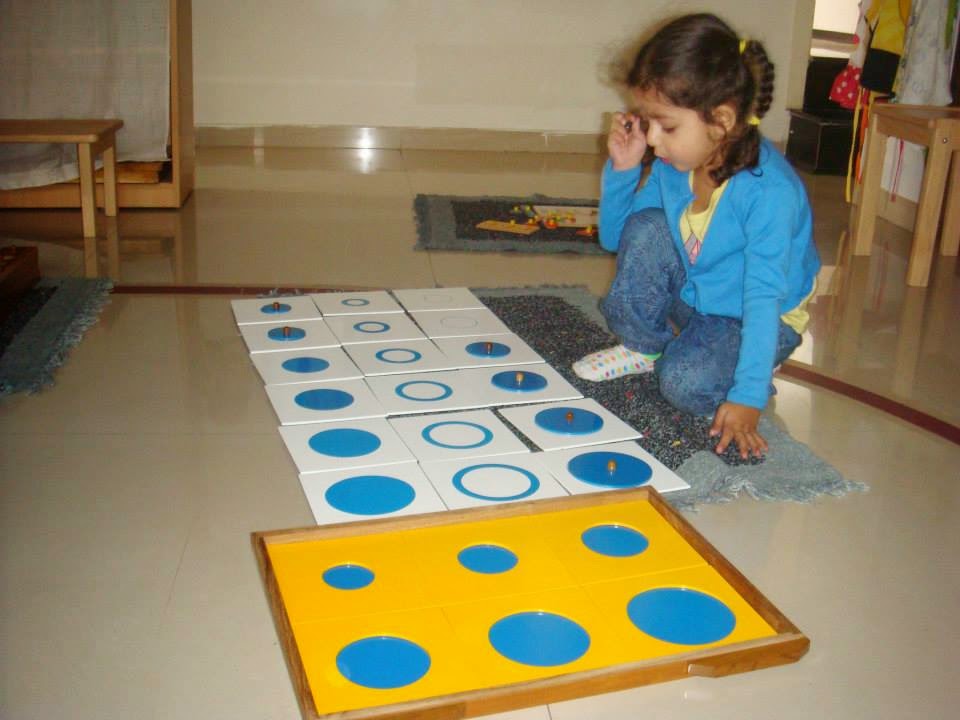
A girl doing Geometrical cabinet by the end of first year in M1 which requires 35-40 minutes of focused attention 

If you compare M1 (equivalent to Nursery) to Nursery year of a normal pre-school, the above statement may seem to be true. So why is the first year slow in Montessori?

Because in the first year, the foundation is being led. The initial period is spent on helping the child sit on the mat without getting distracted. This is done through EPL activities like pounding, cutting cucumbers and self management activities like buttoning shirt and washing hands. In the first year, sensorial activities utilise the 'senses' of the child which help him activate his 'senses' and develop patience. A large set of practices are adopted in Montessori to ensure that the child sees 'mistakes' as a source of learning, instead of being embarrassed or punished by them. As a foundation for teaching English, the child is introduced to at least 100 new words in English per month in the first year through cards and object boxes. Morever, the Montessori adult always speaks with the child in English. Combination of these -  EPL, Sensorial and language - enable the child to work patiently for a longer time without fear of 'mistakes'. 

By the end of first year, with the attention span increased to more than 30 minutes, with no fear of mistakes, the child is willing to learn new things at a faster rate, be it in language, mathematics or Geography. More importantly, his learning is fast because he chooses his activities himself without being forced. He learns it individually at his own pace, not in the group.

So what does this foundation of one year help the child learn in the second and three year of pre-school? By the third year, a Montessori child learns to count add, subtract, multiply and divide 4-digit numbers. Some children even learn fractions. All children learn to count 4-digit number, some even count 6-digit numbers. ( Typically this is learnt in second/third class in normal schools!) In English language, the Montessori child not only speaks, writes English in his own words, but can also read English story books ( which is called comprehensive reading as compared to Mechanical reading). As though this is not enough, a Montessori child is introduced to Geography, Zoology and Botany ( with botanical names for leaves) in the third year, besides being introduced to second language, which could be either Hindi or Marathi in Maharashtra, or Kannada in Karnataka.

At the end of three years, a Montessori child is far ahead of a child in Normal pre-school, both in terms of learning ( be it maths, language or geography) as well as in terms of development ( be it patience, concentration and ability to make his own choices). Piyush understood the benefits of laying doing sound foundation of a child.

As Piyush said it succinctly, Slow is fast in Montessori. It takes time to lay down the foundation in the first year, but once it is laid, then it can achieve huge results in the next two years. 

Saturday, January 24, 2015

Montessori is not activity based learning

Because of the numerous activities used in Montessori method, Montessori is often confused with Activity based learning. However, Montessori method instead strives to re-configure the balance between EAN ( Execution Attention Network) and DMN ( Domain mode Network). EAN is used when the child does activities, while DMN is used with the child is doing internal focused tasks like, daydreaming, reflecting, and changing the perspective. When a child uses activity alone, it is considered to be autistic because he is using too much of EAN, and when a child uses DMN, we consider it to be schizophrenic. The key is balancing EAN and DMN.


Here is how Montessori method balances the EAN and DMN in a pre-school: 

1. Utilising Sense of order

Montessori method uses the time before and after an activity. That is why it stresses on the importance of taking the kit from the shelf as well as keeping it back on the shelf. It also uses the child's sense of keeping things in order such as when the child keeps the boots on the rack, hanging the bag on a specific place and so on. These 'non-activities' use the DMN network of a child.

2. Doing an activity end to end

In Montessori method, EPL activities for instance, have several steps before the activity and after the activity. For instance , pounding activity has several steps before the activity (taking the apron, using oil cloth, taking the nuts in a vessel, putting it in the pastle) of pounding. Similarly, there are activities after pounding. Infact one of the central activity is sharing the pounded nuts with other children. This series of activities enable the child to look at the 'purpose' of an activity and not just the key activity. Shifting the attention to the purpose of activity enables the child to balance between DMN and EAN networks.

3. Creating child-centric method


Unlike any ABL method, the child can 'chose' his own set of activity and perform it as many time as he wishes. As long as the child sits on the working mat, child has freedom of not doing anything in Montessori method. In Montessori, child's voluntary efforts to do any activity are considered to be important if his learning has to happen. Montessori method is student-driven method while ABL is teacher-driven method.

4. Focus on behavioural pattern of child to imbibe the learning habits 

In Montessori, there are EPL, Sensorial, Language and Mathematical activities arranged according to the age of child. These activities, although predetermined, are offered to the child according to his age and the challenge it offers to the child. The focus is not on teaching a 'concept' to a child like in ABL. The focus is on developing three 'behavioural habits/patterns' of a child that aid the child in deepen his learning such as choice, mistake-fearlessness, and patience. Montessori method is development centric method, while ABL is learning-centric method.

Summary

In short, Activity based learning is learning-centric teacher-driven methodology while Montessori method is development-centric student driven methodology.

On the surface, Montessori method looks like an activity based method. But if you scratch the surface and delve deeper, you will realise that activity is used as a 'tool' to serve a different 'end'. In Montessori, Activities are used to help the child to develop the foundation of the personality of a child while in Activity based method, activities are used to help the child learn something better and faster.

Tuesday, December 2, 2014

To alter child's behaviour, it is important to follow the child

If you have read the last month's blog on five levels of learning, you will understand that the school mainly helps the child in learning at a cognitive level ( Level 1 to 3). But some alternative schools, like Waldorf and Montessori, also help the child in developing the 'appropriate behaviours' by following the child.  Here is one example that happened in a Montessori.

In Montessori, adults ( or teachers) are taught to follow the child. This example of learning, described below, occurred at the dining table of a Montessori.


Two children, let us call them Neil and Saket, were eating their tiffin on the dining table. Neil had brought Sabudhana Khicdi , which Saket loves very much. Saket therefore asked for a tbsp of Khichdi to Neil. Neil refused. Saket asked the Montessori Adult to intervene. In such situations, Montessori adult takes a back seat and follows the child. So she asked Saket to directly request Neil. Saket again requested Neil for Khichdi. 

After sometime, Neil gave him a tbsp of khichdi. Saket ate it. But he asked for more. Saket was not eating his tiffin. He kept on looking at Neil's tiffin. He even tried once/twice to directly take the Khichdi from Neil's tiffin. Neil blocked Saket's hand. Saket continued to request, very emotionally. After sometime, Neil again gave him a tbsp of Khichdi. Saket ate it quickly and again asked for more. Then he waited for Neil to give him Khichdi. Neil again gave him a tbsp after some time. Again Saket ate and waited. This drama continued for 10-15 minutes. During this 10-15 minutes, Neil gave him 5-7 tbsp of Khichdi. Saket continued to ask for more but also waited. Neil, who normally does not finish his tiffin, ate his full tiffin that day. Saket waited until his Khichdi was over and then he opened his tiffin. 

What did Saket learn? First, he learnt to request for something which he wanted. Generally children do not learn this. When they want something, they grab it, pull it or cry when they do not get it. Saket avoided these three actions and continued to request in a very right tone. Two, Saket learnt to wait patiently for Neil until he gave. This is perhaps the most difficult habit to learn. Patience. Saket learnt to practice 'patience'. More than anything this habit determines the extent to which the 'potential' of a child unfolds.

What did Neil learn? First, he learnt to 'share'. Neil is an independent child when it comes to eating. He neither asks for any 'food item' from others, nor does he 'give' it to others. For the first time in 4 months, time he 'gave', even though it was little. Surprisingly, 3 days after the event, he brought in Khichdi and gave it to Saket without being requested. No amount of 'cajoling' would have helped Neil's behaviour to change to 'sharing'. Second, he also learnt that 'requesting' for some food item is OK. Next day, Neil asked for a 'cheese dosa' from another girl student. Neil had changed his behaviour.

Many parents want their children to change their child's behaviour, for instance, the habit of sharing, waiting for someone, or requesting before shouting. But they resort to wrong methods - instructing, cajoling, black-mailing, or exhorting. Parents do not know that they cannot change their child's behaviour just by 'instructing' the child. Parents can only 'enable' the conditions and hope that the child learns from it.

Unfortunately, parents are too biased to notice learning situations.  For instance, when i told the above example later to parents, many fathers and mothers said that they would have asked their child 'not to ask for any food item' ( like Saket did). They think that it is akin to begging. Some parents also said that they would have asked their child to 'share'.

Some parents have intuitive sense of what should be done in a situation. But most parents do not know how to enable such 'dense situations' that are ripe for learning. Such dense situations - where emotions and real events happen - are required for learning. Once the situation has been 'enabled', it is important to step back and not interfere in the learning process by letting the 'biases' interfere. In the above example, Montessori adult ( or teacher) watched the proceedings without making any comment. She just followed the children. She was careful to see that Saket did not 'put' his hand in the tiffin of Neil, for instance. Neither did she ask Saket to eat his own tiffin and not 'ask' for anything.

This is a paradox. If you want to change the child's behaviour, it is important to 'follow the child', instead of leading the child. Many parents want to inculcate the right 'culture' ( or what they call 'Sanskar' in marathi or Hindi) in their children, but they do not know how.  Instead of following the child, they constantly try to lead the child.

Thursday, October 9, 2014

Learning is painful, individualistic and idiosyncratic

There is a huge difference between learning and teaching. To understand learning, one has to see it. But how can one see learning when learning happens in the head. So here is a chance to see learning 'happen'. See this video tape of live-learning of a young toddler, which will help us peep into the mind of a learner. 


After seeing this video ( of the child we shall call Adi), you will appreciate three characteristics of learning:

1. Learning is painful

We assume that learning is joy and fun. But contrary to this understanding, learning is painful. We watch this everyday in a Montessori. When a child is 'learning' something real, his face is taut and tense. When he cannot solve a problem, like Adi in the above video, the child is frustrated and often throws the 'items'. Sometimes the child yells and even beats someone closer to her.

Sometimes the pain of learning is seen differently. For instance, when the child works on something where he is learning, like Adi, the effort of learning is so high that he wants rest after doing the activity. Or if we praise 'right' outcome in activities, we have observed that the child avoids taking challenging activities later because he is more worried about performing poorly. 'Praising child for right performance' hampers the child learning. Carol Dweck has documented the effects of performance-anxiety and learning extensively.  Montessori therefore avoids praise.

As the child grows, he or she cannot show this pain easily to others. Instead of showing his frustration of learning, he shows it in more acceptable ways of defiance or disengagement. Without helping the child to assimilate the pain of learning, the child does not learn.

2. Learning is individualistic

Even if the classroom is full of students, every student learns at a different pace. If you see Adi's video above, one can imagine many different ways in which Adi could have been helped to finish the cylinder rods successfully and that too in lesser time. But would our help facilitate Adi's 'learning'? Help, at a wrong time in a wrong way, hampers learning.

In my working in a Montessori, I have realised that the 'right' timing of help is very very tricky. After many such attempts, I have discovered that Montessori's policy of 'not helping' is a better policy. As the child grows old, the policy of 'helping only when asked' is perhaps a better policy to facilitate learning. ( But that too requires planning by the teachers!) Helping a child definitely helps learning, but doing it without hurting the child's self-confidence is a bigger challenge. Help from other children is more effective than help from older adults for the child. And that is why, multi-age classrooms like that of Montessori are more helpful.

Homework system has got maligned in the education system. But due to homework, help from other sources is available to the child. In other words, if the parents can help the child do the homework with the right spirit, it actually helps the child get the right help before it is too late.

3. Learning is idiosyncratic

'Idiosyncrasy' means that learning can happen anytime anywhere. What is Adi learning while putting cylinders in the blocks? He is learning about the physical properties of length and diameters through his senses. He can learn the same 'properties' even when he is working with pink tower? Or trying to put screw in the right hole? Or when he is trying to put his legs in the right shoe? His learning of 'properties' can get 'completed' in any of this instances. Once the child 'sees' the problems, he uses other situations to connect with it. That is why even when the child fails in producing the right outcome, it does not matter.

In our normal coercive learning systems of schools, we always insist only on one 'right way' of learning. We do not help the child in connecting one 'learning problem' with other. When we are teaching latitude/longitude in Geography, for instance, we do not help him connect the same problem with 'Geometry'. Or we do not help him understand the concept of 'light' by showing how India has daylight when USA has night? When using arithmetic operations, you will observe some children struggling with subtraction and addition because of the difficulty in carrying forward 'the tens' in the decimal system. But the same child can easily calculate the amount of money he has to take from the vendor when he is buying toys. In short, Interconnections of concepts across subjects is a major source of learning that we miss in normal schools.

Here parents can immensely help their children. Life is interconnected; subjects in the schools are not. Parents can help their children learn if they can help the child interconnect the concepts in different subjects like geography to water management. Or demonstrate the relevance of concept in real life such as by showing how a bell works. Real-life demonstration like taking child to a real factory also helps.

Summary

Montessori method works because the environment is designed to be 'learning-friendly'. Right from the scientific kits to the method of teaching, everything is designed to help the child tackle the above learning difficulties. Every child is taught individually. That helps the child chose his own pace and convenience. When the child is stuck he learns from others while 'observing' others in the multi-age classroom, because the child can sit and 'do nothing' in Montessori . Because the child is not praised for right outcomes, the child is not afraid of poor performance.

And more importantly, the child is helped to connect his learning with day-to-day life in a continuous manner. For instance, the child connects 2D images of cards with 3D objects all the time. See this example of introducing vegetables with cards.

By laying proper foundation of learning-enabled child, child is helped for his life. It helps him use these practices of learning throughout his life even the external environment is less friendly.

Courtesy and copyright of video: Sapience Montessori House of Children 

Sunday, May 25, 2014

How Montessori method helps a child to increase his attention span

Every teacher of play school and parent assumes that a child will always be active, dancing and moving. Infact some parents also believe that more the child is noisy, more the intelligent she is. But every teacher knows that learning cannot happen until the child sits still and can focus on something for a reasonable period of time. Not just psychologists, every parent also knows this. So it is surprising that only Montessori method has definite methods to increase the attention span of a child.

Montessori does this impossible-looking feat through some innovative 4 design elements of kits, methodology, and use of child psychology. 

1. Montessori Kits are designed to fulfill the innate need of sensitive period. 

This helps the child to do what he most needs. Initially a child takes up EPL activities like pouring water, buttoning, and other activities that makes him independent. Later, the child takes up sensorial activities that uses his senses of sound, taste and touch. No activity is introduced to child until she is ready. For instance, child is introduced to writing only when his readiness is 'measured and identified' by drawing Geometrical insets. Therefore child loves to perform activities because it fulfills his innate need. 

2. In each kit, multiple activities are designed with increasing complexity to prevent onset of boredom . 

If the activities are not challenging, the child leaves the material immediately. That is why children rarely play with toys. In Montessori, multiple activities in  a single kit are designed with increasing challenge. For instance, in a cylinder block, almost 120+ activities can be performed which are increasingly difficult. Because the activities are challenging, the child does not feel bored and remains engaged with the same kit. A child is able to maintain his attention for a longer time. 

3. A child's internal drive is invoked by offering him the full freedom . 

A child has a freedom to perform anything in a Montessori. He can eat at any time, play if he is bored, or just still and do nothing. He also has a choice to repeat an activity n number of times. Her wishes are respected in the Montessori fully. This makes a child feel that he or she can do anything in the Montessori. Because the child realises that he/she need not 'manipulate' anyone to do anything, he is in command. This calms him from inside. This helps him perform the activities without any compulsion for a long time. He is driven by his internal force, rather than by any external pressure of approval from the teacher. 

 4. A child's motivation is kept intact by avoiding the pointing of mistakes as well as praise.

When a child's mistakes are pointed, even though with good intention, he/she is embarrassed and avoids situations and challenges that leads him to make mistakes. In a Montessori, the material kits are self corrective. This enables the child to correct his own errors himself. On the other hand teachers are also trained not to point mistakes. This helps the child to avoid the embarrassment of failing. On the other hand teachers do not even praise. Because there is no praise for doing anything right, the child also does not chose easy activities to get approval. Child therefore performs an activity because of his internal motivation in this scenario.

Consequences of the above four factors: Initially when the child starts with Montessori the child barely sits still. But slowly and surely, helped by the factors  3 and 4 ( freedom and acceptance of mistakes policy), the child manages to use the designed kits and concentrate for 15 minutes to half an hour by the end of first year in Montessori. When the child starts learning English language and arithmetic in the second year, her attention span continues to increase beyond an hour.